The Absence of Death
How the portrayal of death in The Secret Agent evokes the actual feeling of loss in the real world.

If these ideas are intriguing to you, maybe you wish to subscribe to my newsletter.
Other writing
- The Big Questions from last week's Good Ones, which also discusses The Secret Agent
"I think I am starting to manage to forget mom."

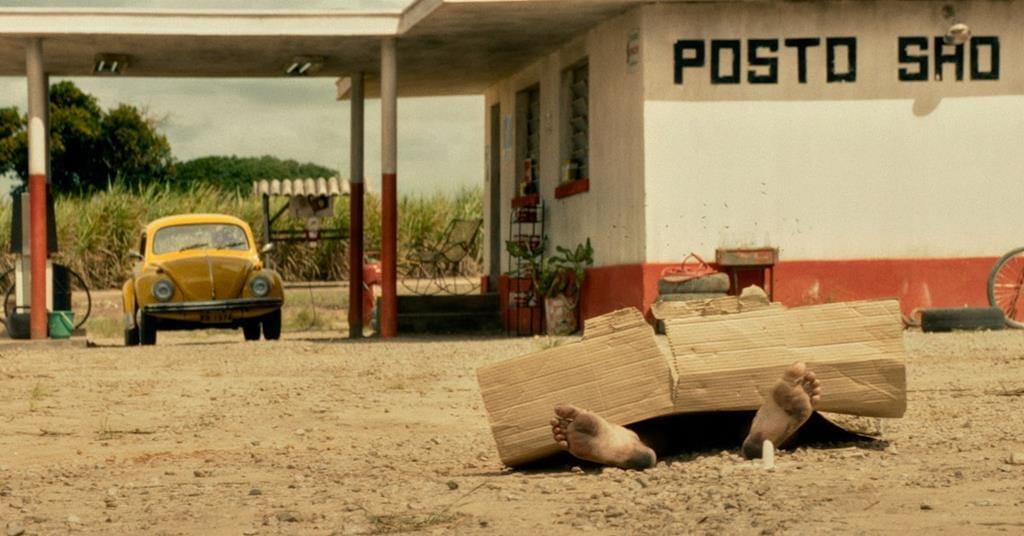
The Secret Agent begins with death. The opening shot shows dirty feet sticking out from under cardboard in the gravel parking lot of a rural gas station. As the distressed attendant splashes water on the windshield of our hero's yellow Beetle, he explains: the dead man tried to steal gas cans, the night attendant shot him, and the police refuse to arrive until the end of Carnival. It's a haunting scene that tilts toward the underlying ugliness of the holiday season in Pernambuco—over 100 people have died during parties, and the police are actively working to cover up the death toll by refusing to process any dead bodies they don't need to.
Death in The Secret Agent works differently than in most films. Action movies celebrate the death of the bad guys, each point-blank headshot becoming a triumphant victory chalked up in the hero's journey. Death in a drama serves as a plot point, pushing characters toward reconciliation and driving the film's momentum. Death in a comedy—well, that's played for laughs. But death in real life doesn't work that way. Death is only experienced by the living, and the living only experience death through absence. It isn't the big moment that you remember when a loved one passes. It's the small moments when you expect someone to be there, and they are not. In The Secret Agent, death hangs over Armando (Wagner Moura) as he feels its absence around him.
I've been thinking about death lately. The height of the global pandemic stripped away our ability to grieve normally. When my aunt passed away during lockdown, her immediate family buried her quietly without a wake or a funeral. Years later, I still haven't processed her death. Her absence feels generic, as if, perhaps, there's still a chance to see her the next time I travel back to Minnesota. I don't remember hearing that she died. The news came and went as all news does over the phone. What I do remember, however, is the way she'd sneak me boxes of sugary cereal when we visited her house on a Sunday, and how she always found a way to let me watch more TV than I was allowed. These are the memories of a child, however. Her absence now is just the absence of any relative who lives states away. I wonder when it'll feel like she's truly gone. It's impossible to describe how death feels in life, because death is the only true unknowable.
What we're describing, really, is a version of negative space. All of the memories of that person suggest the shape of their existence; there's just nothing left in between the lines. When Armando arrives in Recife, a large city in northern Brazil, he's installed in a dead woman's apartment as part of a safe haven complex for refugees. As he walks through it, he walks through her history. All of her records are on the shelf, her furniture is still arranged, and the photos on her wall are untouched. Everything of Geisa is there except for Geisa herself, who was murdered by her jealous boyfriend.
Recife is where Armando's son, Fernando (Enzo Nunes), is staying with his grandparents for safety. On the run from the government, Armando is finally ready to collect his son and flee the country. Though it's never spelled out, the catalyst for this change stems from the death of his wife and the boy's mother, Fátima (Alice Carvalho). Armando explains to Fernando during a car ride that she died of pneumonia; it's hinted at in conversation later that she was targeted for death by men aligned with Brazil's military dictatorship. It's clear that Fátima's absence is felt by father and son alike, but Fernando hasn't processed what her absence means. "When we think of someone, it's like having them with us," Armando tells his son. Fernando counters with an innocent question: "But can she come back?"
Fátima's death haunts Armando. The first thing he does when he arrives at the refugee apartment is to unbox family photographs, lingering slowly on images of the family together while listening to one of Geisa's records. There she is, in a color print, holding Fernando as a baby in the Brazilian sun. It isn't our first time seeing Fátima either—Armando has a photo of her taped to his dashboard during the opening driving scenes. No matter what he tells Fernando in the car, her memory is not enough to keep her with him every day. He needs to see her to remember her presence.
Memory in The Secret Agent is insufficient. Armando remembers his mother, but as the 14-year-old daughter of a housekeeper impregnated by the 17-year-old son of the household she cleaned, her existence lives entirely in memory alone. The audience learns at the end of the film, after a time jump, that Armando's mother was kept as a slave in that household, unable to care for her son as anything other than a servant. If memory were sufficient, he wouldn't feel so compelled to find an official record of her existence. Holding an official document in his hand would serve the same purpose as Fátima's photos: an anchor of that person's memory, definitive proof that their life mattered.
The audience sees good reason for that, too, as police chief Euclides (Robério Diógenes) works overtime throughout the film to cover his department's tracks after disappearing a local student (reason unknown) and other petty criminals and targets of the state with Carnival as cover. As these people go missing, the newspaper prints propaganda stories designed to distract. Instead of documenting missing dissidents, the paper suggests that a disembodied leg (found in a shark) has escaped the morgue and gone on a rampage. It wasn't the police throwing their enemies into a van and driving them off to an unknown fate; it was the Hairy Leg who was the culprit. Never mind that the leg itself belonged to the missing student in the first place. Two birds with one false story.
Brazil in the 1970s was run by a military dictatorship. By 1977, when The Secret Agent takes place, cracks in the regime were forming—the economy started to show signs of the corporate plunder that fueled initial growth earlier in the decade, and in 1979, President João Figueiredo passed an amnesty law that would have cleared Armando of the false corruption charges levied against him. It should be noted that, as an entity, the federal government isn't a direct adversary in this movie. Instead, what we see is the power vacuum filled by corruption on a smaller scale—the local police essentially run a racket for the wealthy, while private business owners like Henrique Ghirotti (Luciano Chirolli), the main antagonist of the film, abuse the levers of state power at their disposal for personal gain. Most importantly, in 1977, if you wanted someone wiped out of history, it was possible for the right price. Armando's story is part of that narrative, one that would be lost to time without the recordings made by the refugee network who attemped to save his life.
Without those recordings, however, there's no physical locus of Armando for Fernando to hold onto. As he explains later in the movie, as an adult, he has no real memory of his father to hold on to. For him, the absence of his parents is a marker of time more than anything. In a post-dictatorship world, adult Fernando (also played by Moura) has his priorities—he's a doctor at a blood bank and focuses on serving the community rather than dwelling on the past. Fernando seems to have neutral feelings about his father. Instead, Armando's life and legacy are more cherished by Flávia (Laura Lufési), a young university employee who follows his story by transcribing the audio tapes of his testimony. In the final moments of the film, when Flávia meets Fernando to learn more about his family's story, he struggles to confront his familial history. "I find it so hard to speak about this," he tells her, and his face shows true discomfort in the moment. When Flávia hands him a USB stick containing all of Armando's interviews, his hand hovers over it for a moment, revealing his hesitation to embrace his father's absence as a presence in his life.
If death in The Secret Agent is about defining absence, life in the film is shown as establishing a presence. Like Armando recalling his encounter with Ghirotti, I told you the story in the wrong order. The Secret Agent actaully begins with life. Before we see the dead body in the dirt, we see archival photographs of life in Brazil in 1977. As radio announcers describe the samba they are about to play, images of people celebrating flash across the screen. Vibrant shots from a nightclub with flamboyantly dressed dancers. Young people walking down the street with fashionable long hair. A middle-aged couple sharing a hammock while one naps and the other reads from a tabloid. Beauty, smiling faces.
As much as The Secret Agent is a movie about grief, it's a celebration of life. As Dona Sebastiano puts it, "Life has bad things, but also good things." It has drinking cachaça with new friends in an old woman's apartment. It has affairs with the beautiful upstairs neighbor. It has dancing in the street through a spontaneous holiday crowd. It has the promise of a new life, somewhere safe, finally living with your son. And because life has all of these things, the absence of death feels even more weighted. It's a weight that we all carry in our lives, but seeing it on film gives that burden its own catharsis.
Fernando tells Flávia that he had nightmares about sharks every night of his life until his grandfather finally took him to see Jaws. Maybe the weight of death can be alleviated the same way by watching The Secret Agent. Or maybe, like the characters in the film, we'll learn to live with the absence of death for the rest of our lives.
Read
- Zero History by William Gibson
Gibson's post-9/11 trilogy is something hard to describe. Rooted in the ever-evolving surveillance state born of the Patriot Act, Gibson can't hide that the thing he's truly interested in is how memetic information travels through the Internet, or in spite of it. It's a fascinating series that looks at information as a tool of the oppressor as much as a license for artistic freedom, which is somehow more relevant in 2026 than when these books were conceived.
Watch
- Strip Law on Netflix
I'm going to have to write one of these things only about Strip Law, so you should watch it all now.
Listen
- We Are Together Again by Bonnie "Prince" Billy
Our boy did another one. What more can you say other than it's a Bonnie "Prince" Billy album?
Consume
Beans exist as a staple of cheap food, and cooking dried beans from scratch is the cheapest way to do it. But the dried beans you get from the bulk bin at the store are prone to splitting and turning to mush before being cooked fully through. I hate to say it, but grabbing some Rancho Gordo beans from the shelf is worth the splurge. They cook up beautifully tender and intact, making them perfect for soups, stews, and salads.
Artwork by Ashley Elander Strandquist. You can view her illustration work here.