The Guy Doing Stuff Theory of Film
Utilizing the power of the moving image to define the medium of film.

If these ideas are intriguing to you, maybe you wish to subscribe to my newsletter.
Other writing
- How I would fix Madison dining at Tone Madison
- How to Sharpen a Knife No Matter Your Skill Level at Bon Appétit
Show, don't tell
My good buddy Jackson, who is the steward of our Movie Club, recently wrote about Project Hail Mary. His newsletter is great—right now he's working through recent movies and movie club entries (we're watching through every major 1977 release in chronological order), but it started as a weekly essay about The Hudsucker Proxy. In any case, you should read his essay on why Project Hail Mary falls short—it's not a Guy Doing Stuff movie. What's a Guy Doing Stuff movie? Well, as I define it (as written out by Jackson in his newsletter):
As the coiner of the term, I’ll present here Jesse’s four pillars of the ideal “guy doing stuff” experience.
- The guy has to be filmed doing stuff.
- He does not narrate what he’s doing or have voiceover.
- The stuff is visually interesting, but it’s not always clear what’s happening.
- It shows a specific level of competence in a specific way.
Given that this is a novel descriptor at present limited to one groupchat, it’s difficult to say what the history of the “guy doing stuff” movie is. I will say that none of us have ever seen a classic Hollywood studio film of the 1920s – 50s that qualifies as a “guy doing stuff” film, but I wouldn’t be at all surprised if there were, say, a Hitchcock film or something that qualifies. What is absolutely the case is that “guy doing stuff” cinema became more commonplace during the French New Wave, with films like Rififi(1955) and Le Samouraï (1967) having long sections of dialogue-free crime activity. New Hollywood followed suit, releasing notable “guy doing stuff” activity in Taxi Driver(1976) as Travis builds his handgun quick-draw rig, and Sorcerer (1977) as the four men attempt to clear the jungle road from a fallen giant tree. In the years since, “guy doing stuff” has become a normal piece of cinematic vocabulary, with recent releases like Send Help (2026), The Mastermind (2025), and Black Bag (2025) all containing excellent “guy doing stuff” material.
The reason Jackson defines Guy Doing Stuff movies through my description is that I first coined the term in our Movie Club group chat to describe my favorite type of movies. The fact that Jackson wrote about Guy Doing Stuff before I wrote about Guy Doing Stuff is, well, a complete and utter failure on my part.
But I thought, hey, why not dig into what Guy Doing Stuff means and why it's important. Mostly, it gives me an easy way to shuttle out another missive with low effort. And I'm tired. And there's a lot of playoff basketball and hockey to watch.
Jackson has a good explainer about the allure of Guy Doing Stuff cinema:
The joy of “guy doing stuff” cinema is the respect it has for the audience. It posits that there is a problem: the three burglars in Thief need to get into a vault door without means of getting in. It then shows the solution to that problem by simply demonstrating how it’s done: a giant three-person blowtorch operation. We’re never told “the fire extinguishers are needed because the thermal energy expended by the blowtorch would otherwise set the building on fire”, we simply see the fires start briefly and the fire extinguisher puts them out. We are never told “the tube on the blowtorch needs to be incredibly long because otherwise the operator would burn their hands”, it’s simply surmised by watching the flame melt several inches of steel like buttercream on a cake in July. We see the problem being solved and its logistical hurdles being overcome in real time. We are not told that the character solved the problem; we are brought into the problem-solving process. Frank and his fellow jewel thieves do not tell us how to get into the safe. It’s that he and the audience figure out the best way to get into this safe together.
He's spot on here—but I think the concept of Guy Doing Stuff goes even deeper into the basic conceptualization of film as a medium. When I took my first film studies class at St. John's University (not that one, or the other one you're thinking about), the professor went student by student, asking why we were taking the class. When I told her I was a writer, she just shook her head. "Writers get everything wrong about film," she said dismissively. "Writers want everything to be narration and dialogue. They want film to be a medium of words."
She was right. I could recite my favorite movie lines by line on demand. I could not tell you about why Wes Anderson framed a shot the way he did, or what effect the camera movement conveyed to the viewer. Film, as my professor repeatedly stated, is a visual medium. Why not use it to build the narrative.
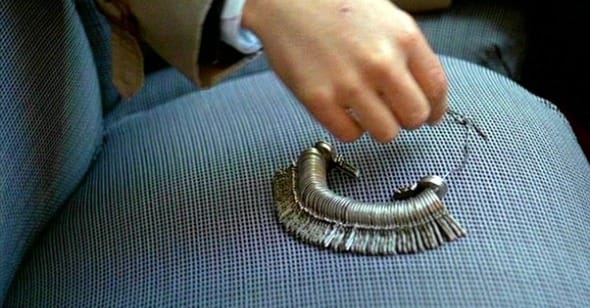
Jackson is right that Guy Doing Stuff brings the audience into the problem-solving on screen, but narratively, Guy Doing Stuff is a bit more complex. For the viewer, Guy Doing Stuff is a series of miniature mysteries. It gives character actions momentum and creates intrigue. In the early minutes of Le Samouraï, the protagonist steps into a car and cycles through a ring of keys until one of them turns over. It's a small moment, but now we know our protagonist is stealing this car. Whoever he is, whatever he's about to do, we know he's willing to commit grand theft auto to get there.
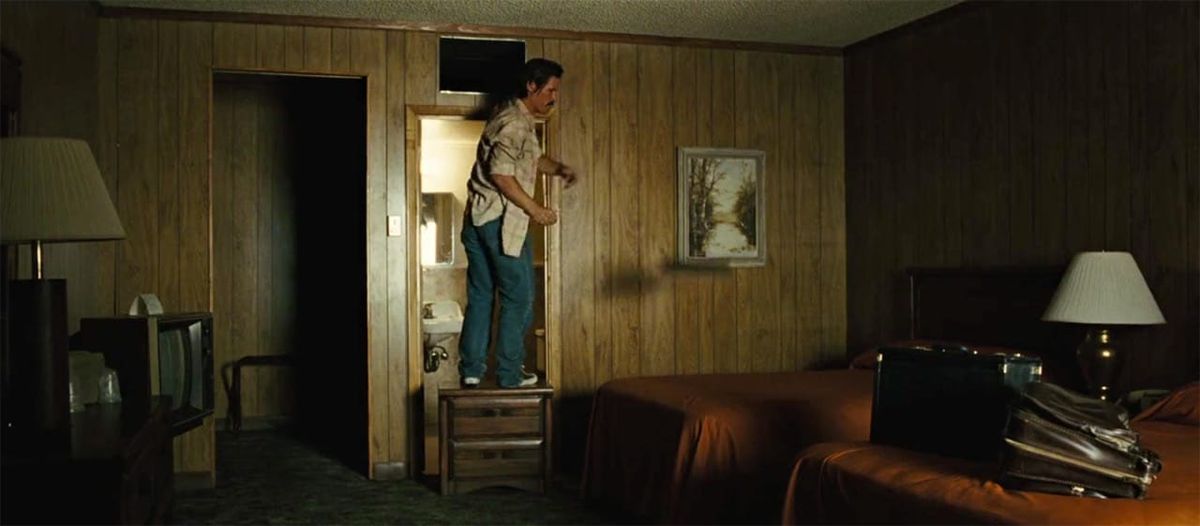
In No Country for Old Men, the Coen Brothers run a near 20-minute dialogue-lite sequence in which the main character, Llewelyn, hides a bag full of money in a motel vent, and then needs to retrieve it when he realizes his room has been compromised. The viewer gets to watch him undo the hanging bar in the closet to shove the case deeper into the vent, cut a curtain drawstring that he uses to tie onto the case so he can pull it back out of the vent, and methodically change the dressings on his wounds in a boot store bathroom. Afterward, we see him buying tentpoles and a shotgun, picking a different room in the motel, sawing off the barrel of the shotgun, cutting the hooks off metal hangers and taping them to tent poles, all in an effort to snag the money bag through the other side of the vent. At the same time, villain Anton Chigurh is seen identifying Llewelyn's room via transponder, renting a different room, and walking through it as a dry run. He practices kicking the door in, he checks for hiding places in the bathroom, he investigates how thick the closet walls are, and then takes off his boots.
The entire sequence is a setup. The Coens then cross-cut between Chigurh dispatching the cartel guys in Llewelyn's original room, with Llewelyn trying to quietly hook his case of money from the opposite side of the motel. It's a race against time, but it's also a solution to a series of visual riddles. What are the tentpoles for? Why does Chigurh run his hands along the closet wall? What's the point in sawing off the shotgun? Why take off your boots? The payoff for each action is satisfying, but it's also building narrative tension that propels the movie forward. The viewer knows that Llewelyn is being tracked before he does, and for nearly 20 minutes, we're sitting there wondering, Well, how is he going to wriggle his way outta this one? Leaving each preparation step in full display invites the viewer to become an active participant in the story. The Coens are going to show you what's happening, but you've got to tie the strings together yourself.
It's difficult to create a Guy Doing Stuff in other media. Alan Moore revolutionized comic book writing by removing unnecessary dialogue and letting character actions speak for themselves, but there are no 12-page dialogue-free sections in Watchmen. Cormac McCarthy (author of the novel No Country for Old Men) gets close to Guy Doing Stuff narration in his books, but it's too tempting to dig into the inner psyche of his characters from time to time. Television, with its long runtimes, is well-suited for Guy Doing Stuff but rarely wants to gamble with losing the audience's attention. A big argument for the difference between prestige television and the regular kind is how much Guy Doing Stuff the showrunner builds into each script. Mad Men delves from time to time, but the king of Guy Doing Stuff TV is Vince Gilligan. Watching Mike press nails through a garden hose in Better Call Saul while he watches old TV is peak Guy Doing Stuff. Of course, it's for a homemade spike strip he's going to use to hijack a semi truck. Why wouldn't it be?
Guy Doing Stuff isn't unique to film, but it thrives there. In the modern attention economy, long, dialogue-free sequences are a gamble. Still, these types of scenes demand active viewing, helping audiences lock in on what's happening on screen, lest they miss the movie's narrative. It's the ultimate test of a visual medium—can you tell a story with just moving image? It's difficult to do, and not many directors can succeed at delivering a full narrative arc without words. When it works, however, it feels like magic.
And why else do we watch film except to feel a little magic touch our everyday li
Read
- You Know, For Kids! newsletter by Jackson O'Brien
Jackson's newsletter is a great look at a variety of films across eras, but the original concept—52 essays about The Hudsucker Proxy—is truly an incredible read. Start with the first essay, which is a 1500-ish word examination of the history of the calendar and why a New Year's Movie is odd, and then jump to the examination of whether Amy Archer is a secret queer icon. Each essay goes deep into the movie, but also goes deep into one of Jackson's general fascinations, which, I can say, are many and intriguing.
Watch
- It Was Just An Accident on Hulu
Jafar Panahi's It Was Just An Accident is a fascinating movie both for what's on screen and for the story behind its production. Panahi is an Iranian filmmaker who has been imprisoned multiple times for being critical of the Iranian government while still choosing to film his movies in Iran without government approval. Each film he makes puts him in literal danger, which makes the story of It Was Just An Accident even more revelatory. In the movie, a man overhears the dragging sound made by an artificial leg that reminds him of his torturer when he was imprisoned. What he decides to do next is take drastic action. It's a fascinating pairing with The Secret Agent—both movies probe what direct and indirect government oppression look like —but it's also an intriguing movie about the nature of revenge worth examining alongside Furiosa. It's now streaming on Hulu, so I encourage you to watch it while you still can.
Listen
Hyperfixed is a fun show—and that fun is contagious. Host Alex Goldman is a great laugher, and his curiosity often leads to fun revelations that trigger big on-air belly laughs. It's not my favorite podcast out there, but it's also a small, independent production that has the ability to do cooler stuff the more subscribers it has. I think the show is worth the subscription, not because you get bonus episodes, but because it supports a small independent show that wants to do good work and do good by its employees. I think that Hyperfixed has the potential to become something truly spectacular, but it's only going to get there if you're willing to invest. And I am. I became a member this week.
Consume
- Tacos
I spent eight days in San Diego for a work conference, and in that time, I ate mostly tacos. Across the Midwest, Mexican food is plentiful and tasty—most small towns have a reliable Mexican restaurant that dishes out delicious platters of fajitas or enchiladas with rice and beans, plus a free basket of tortilla chips. The standard taqueria, however, is more rare. The best Mexican food comes from spots with limited menus, freshly shaving pork from the trompo directly over your tortilla. It's the kind of operation that needs a certain volume to operate, and, well, Madison just doesn't have that kind of demand. So get your ass to Texas, Southern California, or even Chicago and track down the taqueria that's absolutely slamming out some incredible tacos. There's nothing else like it.
Artwork by Ashley Elander Strandquist. You can view her illustration work here.